
By EcoNews Admin
23 October 2026
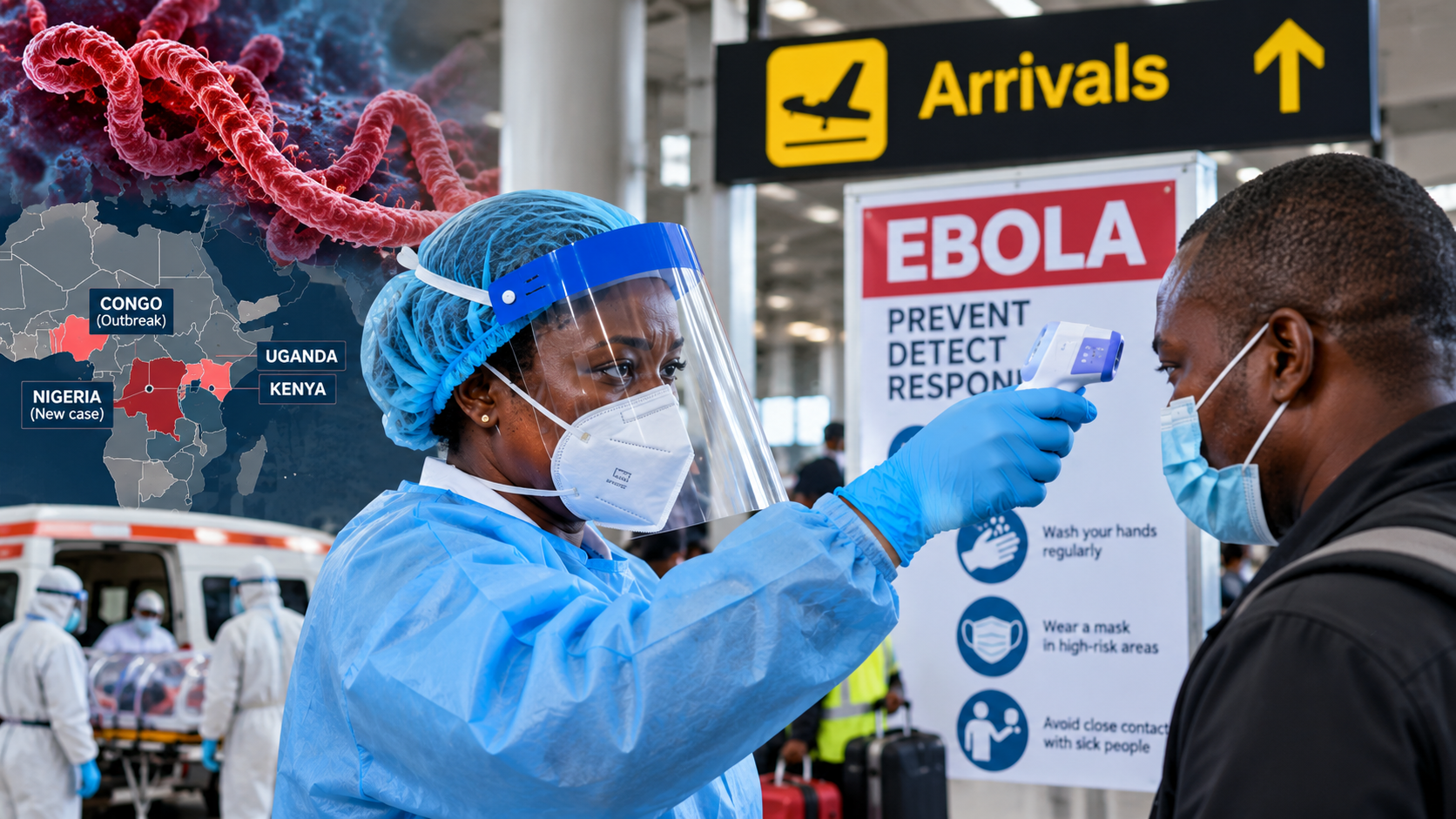
KAMPALA, Uganda — Health authorities across Africa are stepping up surveillance and containment measures following the confirmation of an Ebola case in Nigeria, raising fresh concerns about the spread of the disease across national borders.
Nigeria confirmed the infection in Abuja on 20 October after a woman who had travelled from Uganda tested positive for the virus. The development comes amid an ongoing outbreak originating in the Democratic Republic of Congo (DRC), which has spread to several countries and become a major public health concern.
According to reports by the Associated Press, the patient began experiencing symptoms on 7 October and was admitted to a private hospital in Abuja on 11 October before being diagnosed with Ebola.
Nigeria’s Health Minister, Muhammad Pate, said authorities had initiated contact tracing, identifying 44 people who may have been exposed to the patient.
The Nigerian government has since urged the public to remain calm, with health officials reporting that the patient remains isolated and that there is no evidence of community transmission as of 22 October.
UGANDA’S ROLE IN THE REGIONAL HEALTH RESPONSE
Uganda’s position as a regional transport and travel hub has placed it within the wider network of countries monitoring the outbreak.
The country previously recorded 20 confirmed Ebola cases during the outbreak, including infections involving people who had travelled from neighbouring Congo. Eighteen patients recovered, while two died.
The World Health Organization declared Uganda’s outbreak over on 27 August following the completion of response measures. However, Nigeria’s latest case, involving a traveller who arrived from Uganda, underscores the importance of continued surveillance, cross-border information sharing and rapid identification of suspected infections.
Health authorities are investigating the movements of affected individuals to establish possible exposure pathways. Reports have also raised the possibility that the first Ebola patients identified in Kenya and Nigeria may have crossed paths at Entebbe International Airport on 3 October. Further investigations are needed to establish whether any direct connection exists.
CONGO REMAINS THE EPICENTRE
The outbreak originated in eastern Democratic Republic of Congo in May 2026 and has since developed into one of the most geographically extensive Ebola emergencies reported in Africa.
Figures reported by the Associated Press indicate that Congo has recorded approximately 9,500 infections and at least 4,600 deaths, highlighting the scale of the crisis and the challenges facing health workers in affected communities.
Kenya has also reported infections after the virus was detected in a traveller who arrived from Congo through Uganda. By 21 October, the country had recorded nine cases, with authorities identifying 135 contacts linked to the infections.
France previously reported an infection involving a doctor returning from a humanitarian mission in an affected area of Congo. The patient recovered and was discharged in July, according to the WHO information cited by the Associated Press.
The geographical spread of the outbreak has increased pressure on health agencies to strengthen surveillance, improve laboratory testing and ensure that suspected cases are isolated promptly.
WHY THIS OUTBREAK IS PARTICULARLY CONCERNING
The current outbreak is caused by the Bundibugyo virus, a rare Ebola species for which there is no approved vaccine or specific treatment.
This presents a significant challenge for public health authorities, particularly in areas where access to healthcare is limited and infections may go undetected before patients seek medical attention.
The outbreak has also exposed the difficulties of controlling infectious diseases in a highly connected region where people regularly cross borders for work, healthcare, trade and family obligations.
Delayed detection and the identification of cases after travel have complicated containment efforts, increasing the importance of effective screening, contact tracing and cooperation between neighbouring countries.
Although vaccines and treatments have been developed for other Ebola virus species, these cannot automatically be assumed to provide protection against the Bundibugyo virus.
WHAT AUTHORITIES AND THE PUBLIC SHOULD DO
Health experts emphasise that early detection, infection prevention and public awareness remain essential to controlling Ebola outbreaks.
Authorities are expected to maintain surveillance at points of entry, strengthen preparedness in health facilities and ensure that frontline health workers have appropriate protective equipment and training.
Members of the public should follow official guidance from their respective health authorities, avoid direct contact with the blood and other bodily fluids of suspected or confirmed cases, and seek immediate medical advice if they develop symptoms after a possible exposure.
Symptoms can include fever, fatigue, muscle pain, headache and sore throat, followed in some cases by vomiting, diarrhoea, rash and internal or external bleeding. These symptoms can resemble those of other illnesses, making professional assessment and appropriate testing important.
Anyone who suspects exposure should contact health professionals promptly and follow instructions on safe assessment and care rather than attempting to manage a suspected infection independently.
REGIONAL COOPERATION WILL BE CRUCIAL
Nigeria’s newly confirmed case highlights the continuing challenge of containing Ebola in a region characterised by extensive cross-border movement.
While Nigerian authorities have reported no evidence of community transmission as of 22 October, the effectiveness of contact tracing and continued surveillance will be critical in determining whether the infection remains contained.
For Uganda and its neighbours, the latest developments reinforce the need for sustained preparedness even after an outbreak has been declared over.
As investigations continue, timely information sharing, public cooperation and coordinated action among national health agencies and international partners will remain central to limiting further transmission.