
By Musa Kabanda | Thursday, November 13, 2025
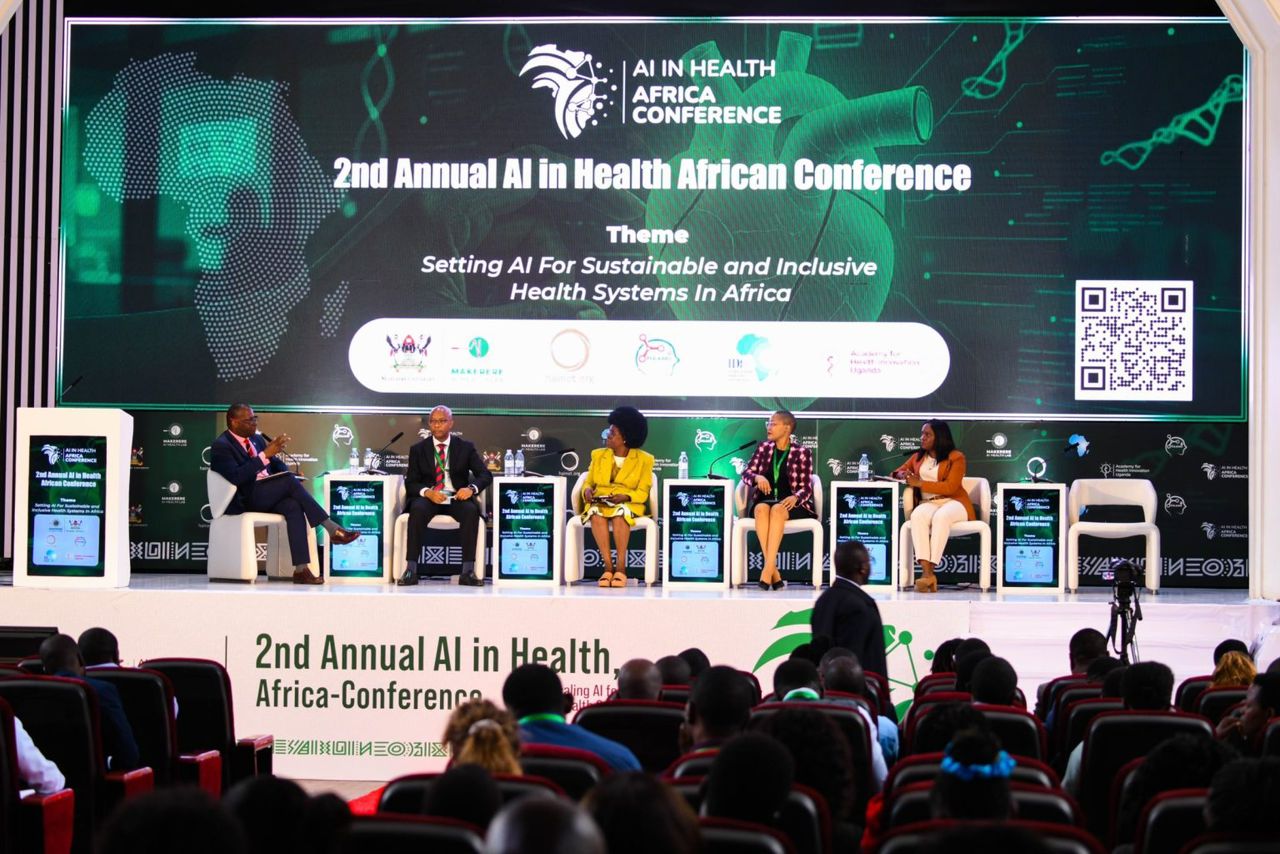
Makerere University once again positioned itself at the heart of Africa’s digital-health revolution as it hosted the Second Annual AI in Health Africa Conference, drawing innovators, researchers, policymakers, and health leaders from across the continent.
Held under the theme “Scaling AI for Sustainable and Inclusive Health Systems in Africa,” the conference showcased real African solutions engineered to tackle persistent healthcare challenges including delayed diagnosis, weak patient-management systems, and resource-limited clinical environments.
AI Innovations Showcased at Makerere
Makerere’s AI Health Lab and partner institutions unveiled practical, home-grown tools now being piloted or deployed across Africa:
- BriskBot Assistant – An AI-powered medical support platform that enhances clinical decision-making.
- BriskMed – A diagnostic and patient-management solution designed for low-resource settings.
- Dawa Assist – A digital adherence tool helping patients manage medications accurately.
- SAM Photo App – A child-nutrition monitoring app using ethical, scalable AI to detect malnutrition.
- ICUConnect – A web dashboard improving ICU-bed referrals and forecasting in Kenyan public hospitals.
- GeoAI for Malaria Prediction – A spatial machine-learning tool using environmental data to forecast malaria outbreaks in Uganda.
These innovations reflect a new era in which African researchers are not only adopting global technologies but designing bespoke systems for African realities.
Strong Calls for Collaboration & Preparedness
Delivering one of the standout keynote addresses, Assoc. Prof. Janice Desire Busingye, Country Director at Astria Learning, challenged institutions to adapt boldly:
“Does the internet know you? What does it know about you? The risk is not the disruption of AI — the risk is institutional irrelevance. We must adopt AI and fundamentally reengineer our educational systems now.”
Her remarks amplified the urgency for universities, governments, and private sector players to move from experimentation to full integration of AI in Africa’s health ecosystem.
Makerere University’s Rose Nakasikiire also emphasized collaboration:
“No one should innovate alone. To truly impact African healthcare, we must break silos and collaborate. Let’s tailor solutions for remote patients, reduce diagnosis time, and integrate tools that work for Africa.”
AI in Medical Training No Longer Optional
According to Makerere researcher Bruce Kirenga, the future of medicine depends on merging clinical expertise with digital intelligence:
“AI won’t replace doctors, but doctors who understand AI will replace those who don’t. We must integrate AI into medical training so our graduates can compete globally.”
Funding Gaps Remain a Major Threat
Despite the excitement, development partners—including Amref Health Africa Uganda—warned that the continent risks stalling if funding remains inconsistent. Without sustainable financing, many prototypes may remain small-scale pilots, unable to reach national or regional health systems where their impact is most needed.
Makerere’s Growing Role in Africa’s Digital-Health Pipeline
This year’s conference reaffirmed Makerere University as one of Africa’s strongest centres of AI-driven health innovation. The institution continues to build a regional ecosystem where research, policy, and private sector efforts converge to create scalable, home-grown health technologies.
As Africa pushes toward data-driven, people-centred health systems, Makerere University’s leadership signals a clear message: Africa is building its own future in health innovation, for us, by us.