
Editorial Desk
13 November 2025
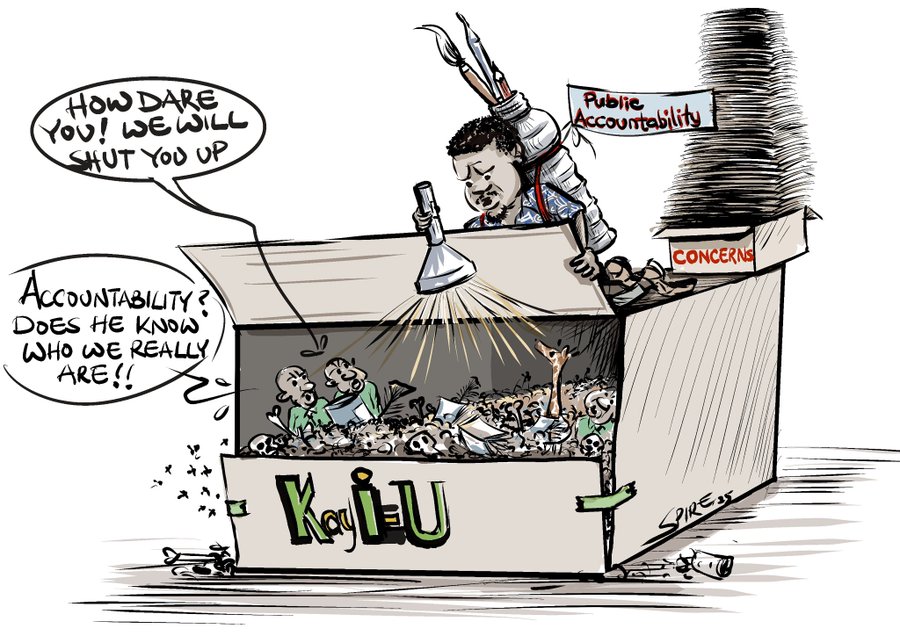
Dr. Jim Spire Ssentongo, philosopher, cartoonist, academic, and at times an unexpected referee of public frustration, opened his inbox and invited Ugandans to send him “everything wrong with KIU”. It is what he has become known for: crowd in, curate, repost, provoke, and watch the reaction unfold. Spire’s voice carries weight in Uganda’s academic ecosystem, and his reputation for public interventions is widely recognised. This is why the moment demands clarity. If the allegations are true, KIU must confront them head-on, not for social media applause but to reassure every student, parent, academic or administrative staff member, alumnus, development partner, regulator, government agency representative, member of the media and the general public who hold the university to a higher standard.

Yet it is worth noting something interesting at the start. KIU sits in a pool of at least thirty-eight universities across Uganda. Some reports list more than forty. Others list as many as sixty when counting all private players. Yet in a landscape this wide, the crocodile chose the twenty-five-year-old meat for its digital bite. Why KIU? Why now?
The exhibition began with an unexpected quiet. For several days it felt like a match struck against damp wood. Messages were coming in, but the fire refused to grow. Only later did a new wave of activists and commentators join the conversation, suddenly loud, suddenly coordinated, after watching silently as Spire tried alone to push the current. Why the late surge? Were they waiting for the perfect moment? For safety in numbers? For public appetite to rise? Or, in the spirit of honest sarcasm, were they being “sent” to the fight? These are open questions, not accusations, because timing often reveals motive in ways words do not.
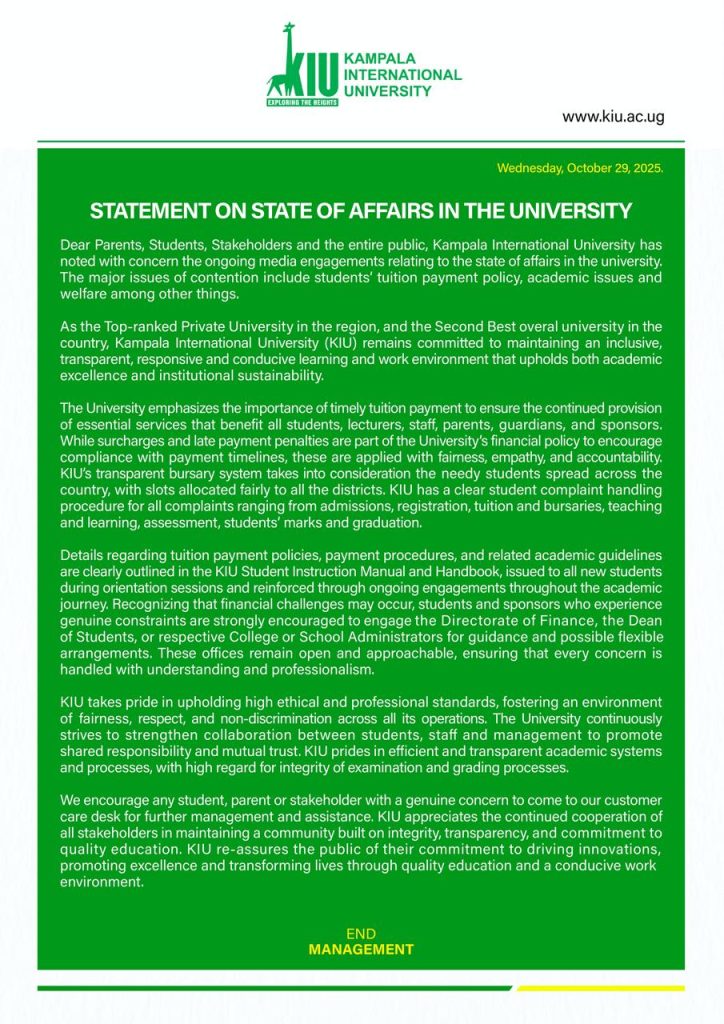
What finally surfaced on Spire’s feed is not trivial. Allegations of surcharges, lab fees, delayed services, staffing gaps, welfare concerns, ranking confusion, and yes, the sensitive allegations of sexual harassment and sex-for-marks all made their way into the exhibition. KIU responded twice, first on 30 October, then again on 12 November, stressing openness and a commitment to constructive engagement. But if two formal clarifications were not enough to ease concerns, then KIU should ask itself why. Stakeholders expect more than words. They expect systems, reforms, timelines and follow-through. As one education expert once said, “A clarification without a correction is a speech, not a solution.”
This is why KIU must be put to task. Twenty-five years of existence is an achievement, but it does not grant immunity from scrutiny. If there are fee inconsistencies, they must be audited. If student support systems are weak, they must be rebuilt. If staffing gaps exist, they must be addressed transparently. If governance concerns linger, they must be confronted. That is what accountability means.
But the other half of the puzzle cannot be ignored. Spire is not a neutral bystander. He is affiliated with leading academic institutions, active in intellectual circles and community networks that influence narratives. He is connected to Makerere University, Uganda Martyrs University Nkozi and the Uganda Management Institute. These are not small affiliations. Uganda’s academic environment is compact, political and sensitive to rivalry. Institutional pride, professional tensions and quiet alliances often shape commentary far more than the public sees. This raises a fair question: is this strictly a grassroots exhibition, or an echo amplified by colleagues who may not speak publicly but whisper privately? It is not an accusation, only an honest thought in a competitive landscape.
Still, a deeper layer lies beneath. Why would Spire, who has no personal history at KIU, push this exhibition so firmly? Are there colleagues behind him with old frustrations? Could this be an indirect outlet for institutional rivalry? Or does the campaign’s length help him gain digital influence, visibility or what people casually call “social capital”? The answer remains unknown, but curiosity is not a crime. As one scholar put it, “In public activism, motives matter as much as messages.”
At the same time, something very human sits at the heart of KIU. The chairman of the Board of Trustees, Hajj Dr Hassan Basajjabalaba, recently lost his mother, Hajjat Azida Nanteza Basajjabalaba, who passed away in Germany. Leaders grieve, but institutions do not pause. It is a painful duality. Public scrutiny rarely slows down out of respect for private mourning, yet moments like these remind us that institutions are ultimately run by people carrying burdens unseen.

Widening the lens, politics adds another quiet shadow. Earlier this year, Basajjabalaba and King Ceasor Mulenga were locked in a highly publicised contest within the NRM Entrepreneurs League. The contest ended in consensus, but the public remembers the rivalry. It is not unreasonable to ask whether some of the noise around KIU is coloured—consciously or unconsciously—by that political history. Again, no conclusion, only context.
But here is where the terrain sharpens. The Computer Misuse Act in Uganda is not soft law. It is a hard-edged framework that criminalises defamatory statements, unauthorised data sharing, cyber harassment, malicious information and social media misuse. Penalties range from heavy fines to long custodial sentences. These are not hypothetical consequences. Courts have already enforced them. KIU’s legal advisers should know this. And Spire, too, must know that if proceedings commence, the law evaluates evidence, not influence. And what if the court interprets ongoing posts as contempt? That question hangs quietly but firmly in the background.
All this leaves us with parallel obligations. If every repost in the exhibition is accurate, KIU must treat them not as an attack but as a checklist for reform: independent reviews, open inquiries, clear deadlines and proactive communication. And if some reposts contain distortions, exaggerations or malicious additions, Spire and those amplifying him must be ready to retract, apologise or face legal consequences. Accountability must cut both ways. “Fairness is not a weapon; it is a scale,” an ethicist once said.

The anonymity of submissions complicates everything. As one academic observed, “A grievance is a truth to one person, a misunderstanding to another and a puzzle to everyone else.” How many submissions reflect systemic reality, and how many reflect individual experiences magnified by emotion? That answer requires investigation, not speculation.
South Africa’s #FeesMustFall movement taught the continent that online activism is not background noise. It accelerates rapidly, amplifies solidarity and exposes institutional cracks. Universities that resisted only deepened their wounds. Those who listened transformed. KIU’s managers would be wise to remember that lesson.
We are witnessing the convergence of activism, institutional defence, academic rivalry, politics, grief and the law. It is too early to declare winners or losers. Something deeper is unfolding, and perhaps it is too early to call it. We stand at a crossroads of information, emotion, legality and institutional vulnerability. All we can do now is follow the questions, not the noise. The truth will take shape through investigation, transparency and the courage of everyone involved to accept what emerges.
For now, the story remains open.
And with that, I am stepping away briefly to buy data, so I can return and see what they both post next.